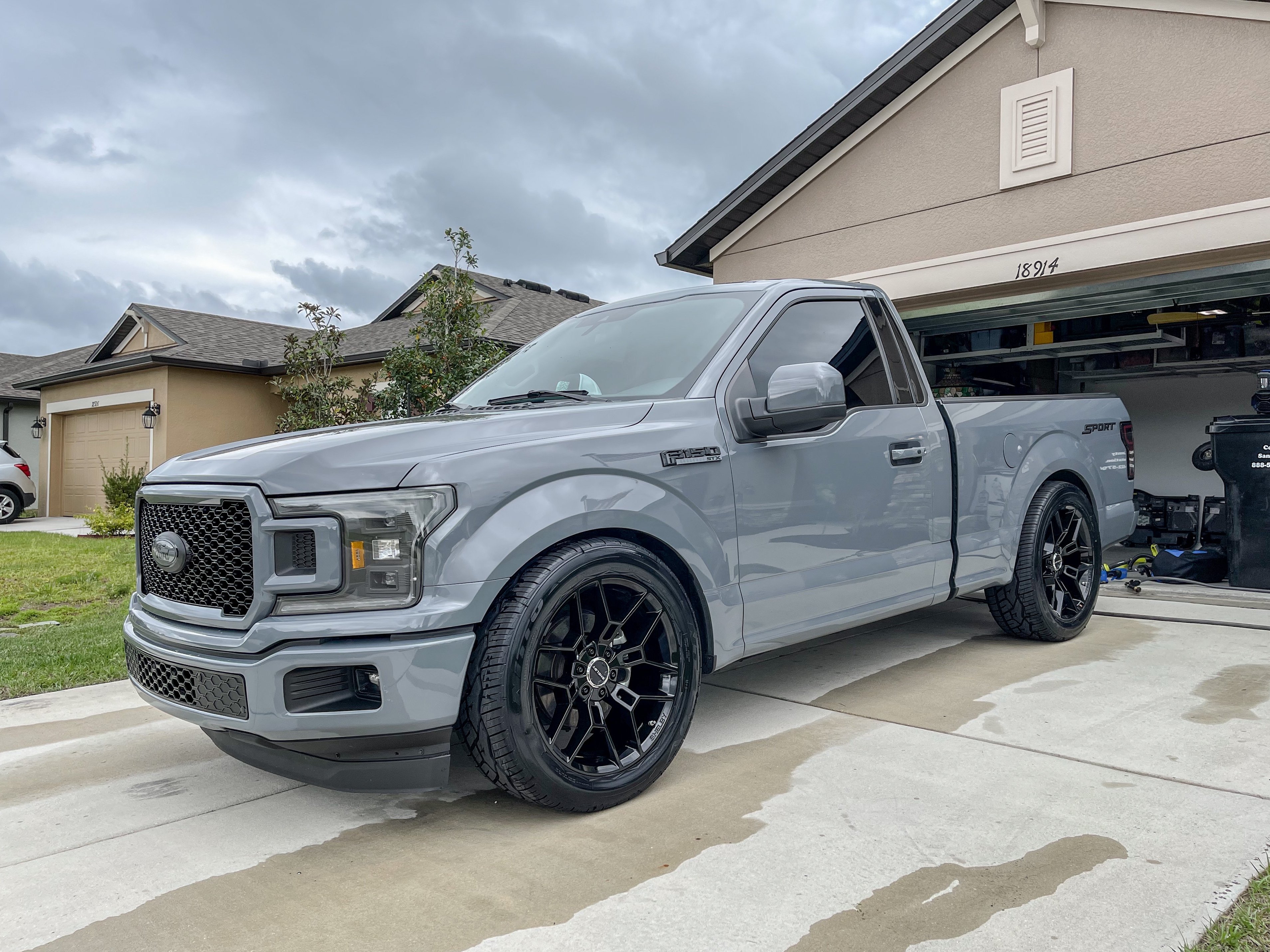
If you're shopping for aftermarket wheels, the bolt pattern is the first spec you need to nail down. Get it wrong and your new wheels won't bolt on — or worse, they'll seem to fit but won't seat safely. This guide covers everything you need to know: what a bolt pattern is, how to measure yours, the exact bolt patterns for every major truck on the road (F-150, Silverado, Ram, Tundra, Tacoma, Sierra, and more), conversion charts between metric and imperial, and practical advice on dual-drilled wheels, adapters, and fitment pitfalls. Whether you're upgrading to a set of aftermarket wheels or just trying to figure out what fits your truck, you'll find your answer here.
What Is a Wheel Bolt Pattern?
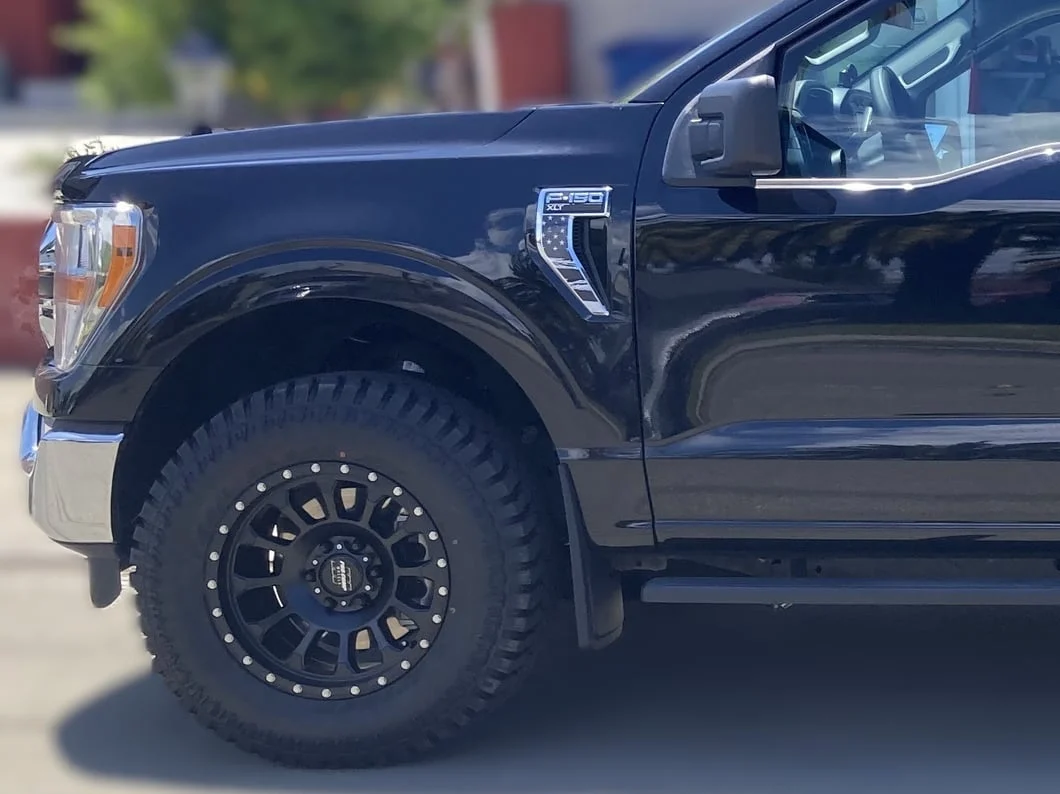
A bolt pattern — also called a lug pattern or pitch circle diameter (PCD) — is the arrangement of lug holes on your truck's wheel and hub. It's expressed as two numbers: the first is the number of lugs, and the second is the diameter of the imaginary circle that passes through the center of each lug hole. For example, a 6x135 pattern means there are six lugs spaced evenly along a circle that measures 135 mm across.
Every aftermarket wheel is designed for a specific bolt pattern, and it must match your truck's hub exactly. If the pattern doesn't line up, the wheel simply won't bolt on — or worse, it'll seem to fit but won't seat properly, which creates a dangerous situation once you're rolling down the highway. This is the single most important spec to verify before you buy new truck wheels and rims.
You'll see bolt patterns listed in either metric (millimeters) or imperial (inches), and they're fully interchangeable. A 5x127 pattern is the same thing as 5x5" — just different units. We'll cover conversion charts later in this guide so you can translate between the two formats quickly. If you want a deeper dive into how different bolt pattern types compare across vehicle classes, we've covered that separately.
Truck bolt patterns generally fall into three categories based on lug count:
- 5-lug: Common on midsize trucks and some older half-ton models. Examples include 5x127 (5x5") and 5x139.7 (5x5.5").
- 6-lug: The standard for modern half-ton trucks. The two most common are 6x135 (Ford) and 6x139.7 (GM, Ram, Toyota, Nissan). Browse aftermarket 6-lug wheels to see what's available.
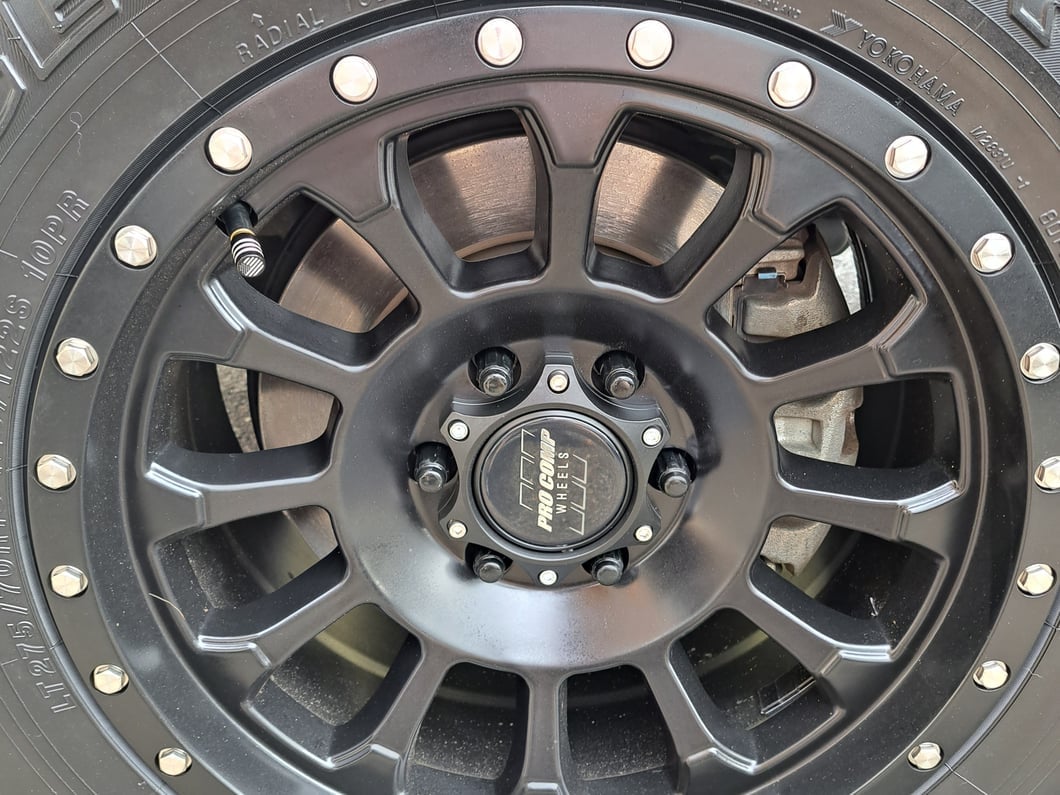
- 8-lug: Found on heavy-duty three-quarter-ton and one-ton trucks. The most common are 8x165.1 (8x6.5"), 8x170, and 8x180.
How to Measure Your Truck's Bolt Pattern
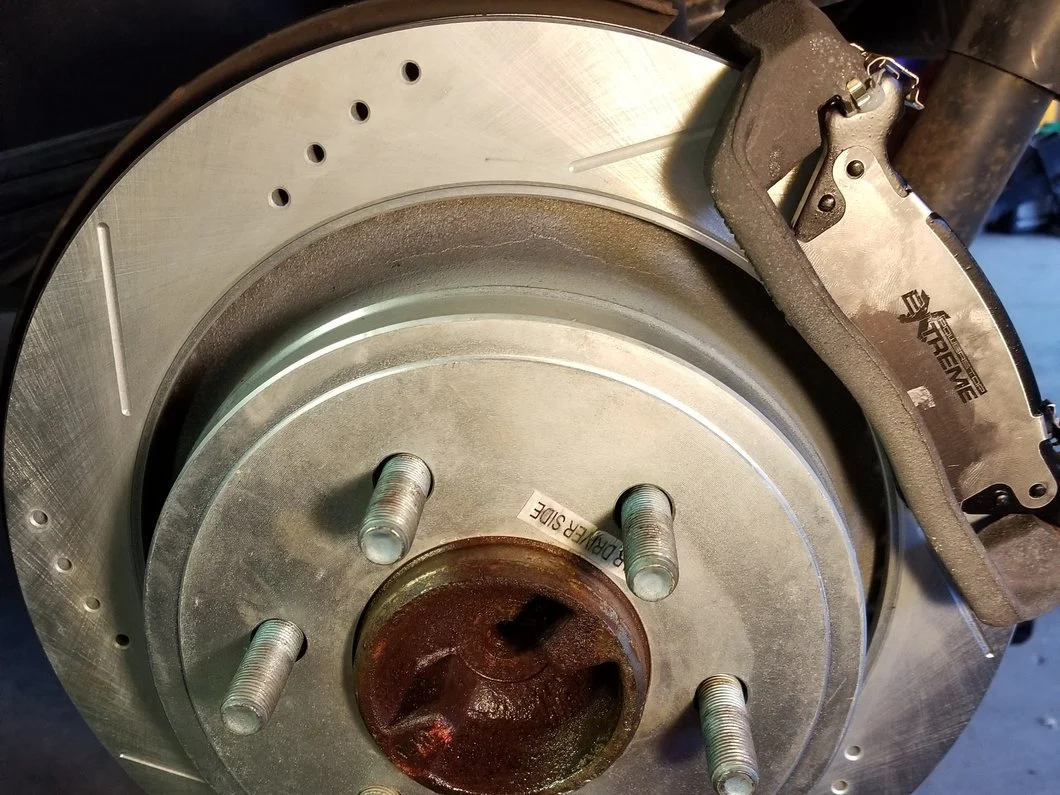
The easiest way to find your truck's bolt pattern is to measure it yourself — all you need is a tape measure or calipers. Count the number of lug holes first, then measure the distance across the bolt circle. The method changes slightly depending on whether your wheel has an even or odd number of lugs.
Even-Lug Patterns (4, 6, and 8-Lug)
If your truck has an even number of lug holes — which covers most 6-lug half-tons and 8-lug heavy-duty trucks — measuring is straightforward. Pick any lug hole and measure from its center straight across to the center of the hole directly opposite. That measurement is your bolt circle diameter (the second number in your bolt pattern).
For a 6-lug wheel, every hole has one directly across from it, so you can measure from any pair. For an 8-lug wheel, the same principle applies — just make sure you're going straight across the wheel, not to an adjacent hole.
Odd-Lug Patterns (5-Lug)
Five-lug patterns are trickier because no two holes sit directly opposite each other. To get an accurate measurement, measure from the center of one lug hole to the far edge of the hole farthest away from it (which will be the one roughly opposite, offset slightly). This "center to far edge" method gives you the bolt circle diameter.
A common mistake is measuring center-to-center on a 5-lug wheel — that'll give you a number that's slightly smaller than the actual PCD. If your measurement doesn't match a known bolt pattern, you're likely off by a few millimeters from this error. When in doubt, use a bolt pattern gauge tool — it removes the guesswork entirely.
Tools You'll Need
- Tape measure or ruler: Works for getting in the ballpark, but precision can be tricky on larger bolt circles.
- Calipers: A digital caliper gives you millimeter-accurate readings, which matters when you're trying to tell the difference between a 5x127 and a 5x120.65 pattern.
- Bolt pattern gauge: A dedicated tool with pre-drilled templates for common patterns. You place it against your hub, and the one that lines up perfectly is your pattern. Fast, accurate, and inexpensive.
Other Ways to Find Your Bolt Pattern
If you'd rather not break out a measuring tool, there are a few other ways to confirm your truck's bolt pattern:
- Owner's manual: Your manual typically lists wheel specifications, including bolt pattern, hub bore, and recommended wheel size.
- Wheel stamp or sticker: Check the back of your factory wheel. Many OEM wheels have the bolt pattern stamped or labeled on the inside barrel or behind a spoke.
- Online lookup: Use our vehicle fitment tool at AmericanTrucks — select your year, make, and model, and we'll show you the bolt pattern along with every wheel that fits.
- Door jamb sticker: Some trucks include tire and wheel specs on the driver's side door jamb placard, though bolt pattern isn't always listed there.
Truck Bolt Patterns by Make, Model & Year
The Ford F-150 uses a 6x135 mm bolt pattern across all models from 2004 to the present day, including the standard cab, SuperCab, SuperCrew, Raptor, Lightning EV, and Tremor variants. Earlier F-150s (1997–2003) used a 5x135 pattern, so if you're shopping wheels for an older F-150, make sure you're getting the right lug count. Check out our F-150 wheel sizing guide for model-specific fitment details, or browse 6-lug F-150 wheels to see what's available.
The Chevy Silverado 1500 uses a 6x139.7 mm (6x5.5") bolt pattern across all generations, from the 1999 body style through the current T1 platform. This is one of the most universal bolt patterns in the truck world — it's shared with the GMC Sierra 1500, Ram 1500, Toyota Tundra, and Nissan Titan, which means you'll have a massive selection of truck wheels and rims to choose from.
The Ram 1500 also runs a 6x139.7 mm (6x5.5") bolt pattern, making it bolt-pattern-compatible with the Silverado 1500, Sierra 1500, and most full-size trucks from GM, Toyota, and Nissan. This has been consistent across the DS, DT, and current generations. Note that hub bore size can still differ between makes, so a hub-centric ring may be needed even when the bolt pattern matches.
Here's the complete truck bolt pattern reference table. Use it to find the exact bolt pattern for your make, model, and year range.
|
Make
|
Model
|
Years
|
Bolt Pattern
|
Hub Bore (mm)
|
|
Ford
|
F-150
|
1997–2003
|
5x135
|
87.1
|
|
Ford
|
F-150
|
2004–present
|
6x135
|
87.1
|
|
Ford
|
F-250 / F-350 (Super Duty)
|
1999–present
|
8x170
|
124.9
|
|
Ford
|
Bronco (6th Gen)
|
2021–present
|
6x139.7
|
93.1
|
|
Ford
|
Ranger
|
2019–present
|
6x139.7
|
93.1
|
|
Ford
|
Ranger
|
1998–2011
|
5x114.3
|
70.3
|
|
Chevy
|
Silverado 1500
|
1999–present
|
6x139.7
|
78.1
|
|
Chevy
|
Silverado 2500 HD / 3500 HD
|
2011–present
|
8x180
|
124.1
|
|
Chevy
|
Silverado 2500 HD / 3500 HD
|
1999–2010
|
8x165.1
|
116.7
|
|
Chevy
|
Tahoe
|
2000–present
|
6x139.7
|
78.1
|
|
Chevy
|
Colorado
|
2015–present
|
6x120
|
67.1
|
|
Ram
|
1500
|
2002–present
|
5x139.7
|
77.8
|
|
Ram
|
1500 (DS / Classic)
|
2019–present
|
6x139.7
|
77.8
|
|
Ram
|
2500 / 3500
|
2003–present
|
8x165.1
|
121.2
|
|
GMC
|
Sierra 1500
|
1999–present
|
6x139.7
|
78.1
|
|
GMC
|
Sierra 2500 HD / 3500 HD
|
2011–present
|
8x180
|
124.1
|
|
GMC
|
Sierra 2500 HD / 3500 HD
|
1999–2010
|
8x165.1
|
116.7
|
|
GMC
|
Yukon
|
2000–present
|
6x139.7
|
78.1
|
|
GMC
|
Canyon
|
2015–present
|
6x120
|
67.1
|
|
Toyota
|
Tundra
|
2007–2021
|
5x150
|
110.1
|
|
Toyota
|
Tundra
|
2022–present
|
6x139.7
|
106.1
|
|
Toyota
|
Tacoma
|
2005–present
|
6x139.7
|
106.1
|
|
Toyota
|
4Runner
|
2003–present
|
6x139.7
|
106.1
|
|
Nissan
|
Titan
|
2004–present
|
6x139.7
|
78.1
|
|
Nissan
|
Frontier
|
2005–present
|
6x114.3
|
66.1
|
A few things to note about this table: Ram 1500 trucks have transitioned across bolt patterns over the years. Older models (2002–2018) used a 5x139.7 (5x5.5") pattern, while the redesigned DT platform (2019+) moved to 6x139.7. The Ram 1500 Classic, which continued alongside the DT, kept the 5-lug pattern through some model years, so always verify by year and trim. Similarly, the Toyota Tundra switched from a 5x150 pattern to 6x139.7 starting with the 2022 model year.
Bolt Pattern Conversion Chart
No, 5x5 and 5x5.5 are not the same bolt pattern. A 5x5" pattern equals 5x127 mm, while a 5x5.5" pattern equals 5x139.7 mm — that's a 12.7 mm difference in bolt circle diameter. Wheels designed for one will not fit the other. This is one of the most common mix-ups when shopping for aftermarket truck wheels, so always double-check whether the listing is using inches or millimeters.
The charts below convert every common truck bolt pattern between metric and imperial so you can compare specs across different wheel manufacturers. Some brands list patterns in millimeters, others in inches — these tables let you translate instantly.
5-Lug Conversion Chart
|
Metric (mm)
|
Imperial (inches)
|
Common Trucks
|
|
5x10⁸
|
5x4.25"
|
Ford Ranger (older), some SUVs
|
|
5x114.3
|
5x4.5"
|
Ford Ranger (1998–2011), Jeep
|
|
5x120.65
|
5x4.75"
|
Older Chevy/GMC S-10, Blazer
|
|
5x127
|
5x5"
|
Jeep Wrangler JK/JL, older GM SUVs
|
|
5x135
|
5x5.31"
|
Ford F-150 (1997–2003)
|
|
5x139.7
|
5x5.5"
|
Ram 1500 (2002–2018), Suzuki
|
|
5x150
|
5x5.91"
|
Toyota Tundra (2007–2021), Sequoia
|
6-Lug Conversion Chart
|
Metric (mm)
|
Imperial (inches)
|
Common Trucks
|
|
6x114.3
|
6x4.5"
|
Nissan Frontier, Xterra
|
|
6x120
|
6x4.72"
|
Chevy Colorado, GMC Canyon
|
|
6x127
|
6x5"
|
Chevy Trailblazer, Envoy
|
|
6x135
|
6x5.31"
|
Ford F-150 (2004+), Expedition, Navigator
|
|
6x139.7
|
6x5.5"
|
Silverado 1500, Sierra 1500, Ram 1500 (2019+), Tacoma, Tundra (2022+), Titan, 4Runner, Bronco
|
8-Lug Conversion Chart
|
Metric (mm)
|
Imperial (inches)
|
Common Trucks
|
|
8x165.1
|
8x6.5"
|
Ram 2500/3500, Chevy/GMC 2500/3500 (pre-2011)
|
|
8x170
|
8x6.69"
|
Ford F-250 / F-350 Super Duty (1999+)
|
|
8x180
|
8x7.09"
|
Chevy/GMC 2500/3500 HD (2011+)
|
|
8x200
|
8x7.87"
|
Ford F-450 / F-550 (dually front)
|
Understanding Dual-Drilled Wheels
![]() Dual-drilled wheels are safe when installed correctly with the proper hub-centric rings. A dual-drilled (or dual-pattern) wheel has two sets of bolt holes drilled into it, allowing it to fit two different bolt patterns. The most common example is a wheel drilled for both 6x135 and 6x139.7, which means it can fit a Ford F-150 and a Chevy Silverado 1500.
Dual-drilled wheels are safe when installed correctly with the proper hub-centric rings. A dual-drilled (or dual-pattern) wheel has two sets of bolt holes drilled into it, allowing it to fit two different bolt patterns. The most common example is a wheel drilled for both 6x135 and 6x139.7, which means it can fit a Ford F-150 and a Chevy Silverado 1500.
Dual-drilled wheels are popular for a few good reasons:
- Wider vehicle compatibility: One wheel fits multiple trucks, which gives manufacturers (and shoppers) more flexibility.
- Better resale value: If you sell your truck or swap to a different make, dual-drilled wheels may transfer to the new vehicle.
- Larger style selection: Wheel makers can offer more designs profitably when one SKU covers two bolt patterns, which means more options for you. There are a few things to watch for with dual-drilled wheels:
- Hub-centric rings are required: Because a dual-drilled wheel has a larger center bore to accommodate multiple hubs, you'll need a hub-centric ring to center the wheel precisely on your hub. Without it, you'll get vibration at speed. Pick up a set of F-150 hub-centric rings if you're running dual-drilled wheels on a Ford.
- Lug seat type matters: Verify that the lug seats (conical, spherical, or flat) on the dual-drilled wheel match the lug nuts your truck uses. Using the wrong lug seat type can prevent the wheel from seating properly.
- Don't confuse dual-drill with adapters: A dual-drilled wheel is engineered for two patterns from the factory. A wheel adapter bolts between your hub and a wheel with a different pattern — that's a very different setup with different safety considerations.
Wheel Adapters and Spacers
Wheel adapters and spacers let you modify your truck's effective bolt pattern or wheel offset, but they come with trade-offs you should understand before installing them.
Wheel adapters bolt to your hub and provide a new bolt pattern on the outward face. For example, an adapter could convert a 5x139.7 hub to accept 6x139.7 wheels. They're useful when you want to run a wheel that doesn't match your truck's factory pattern, but they add an extra connection point between the wheel and the hub — which is a potential failure point.
Wheel spacers don't change the bolt pattern. They push the wheel outward from the hub to create a wider stance or clear suspension components. Spacers come in two styles:
- Slip-on spacers: Fit over the existing studs with no additional hardware. Typically limited to thinner sizes (5–15 mm) and rely on the factory studs for clamping.
- Bolt-on spacers: Bolt directly to the hub with their own studs protruding outward. These are more secure for thicker applications (20 mm and up) because the wheel mounts to dedicated studs on the spacer itself.
A few safety guidelines if you're considering adapters or spacers:
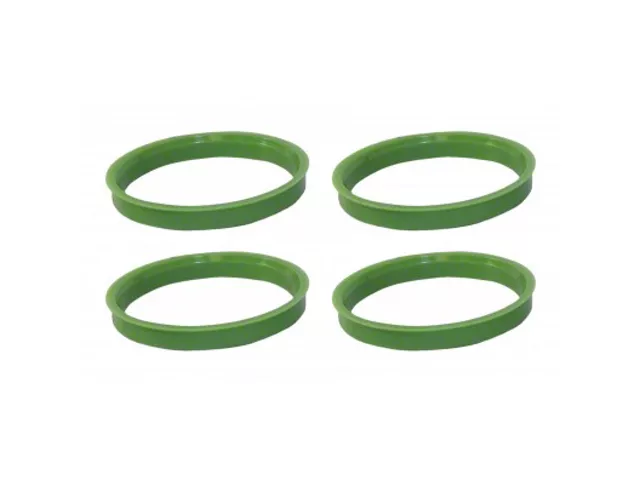
- Use hub-centric designs: Hub-centric spacers and adapters center on your hub bore rather than relying on the lugs alone. This eliminates vibration and distributes load properly. We carry Silverado hub rings and Ram hub-centric rings if your setup needs them.
- Torque to spec and re-torque: Follow the manufacturer's torque specification for the adapter or spacer, and re-torque after the first 50–100 miles. Under-torqued spacers can loosen over time.
- Avoid stacking: Never stack multiple spacers together. If you need more offset, get a thicker single spacer or a wheel with the correct offset built in.
- Know your use case: Adapters and spacers are generally acceptable for street driving and light off-roading. For heavy towing, serious off-road abuse, or competition use, matching the OEM bolt pattern directly is always the safest option.
Close-But-Not-Identical Bolt Patterns
No, you can't put 6-lug wheels on a 5-lug truck — even if the bolt circle diameter is the same, the number of lugs must match. And even when the lug count matches, patterns that are close in diameter are not interchangeable. Just because a wheel bolts on doesn't mean it fits correctly.
Here are the most commonly confused near-match bolt patterns in the truck world:
- 6x135 vs. 6x139.7: Only 4.7 mm apart. A 6x135 wheel (Ford F-150) and a 6x139.7 wheel (Silverado, Sierra, Ram, Tacoma) may appear to line up, but the studs won't seat in the lug holes properly. You'll get uneven clamping, which leads to vibration, wobble, and potential wheel separation.
- 8x165.1 vs. 8x170: Less than 5 mm apart. The 8x165.1 pattern (Ram 2500/3500, older GM HD trucks) and the 8x170 pattern (Ford Super Duty) are close enough that some owners have forced a wheel onto the wrong hub. This is dangerous — the studs sit at a slight angle, which weakens the connection and can lead to failure under load.
- 5x127 vs. 5x120.65 vs. 5x114.3: These three 5-lug patterns span a 12.7 mm range, and none of them are interchangeable. A wheel designed for 5x127 will not properly fit a 5x114.3 hub, even though both are 5-lug patterns.
The bottom line: if a wheel "kind of" bolts on but requires force, wobbles on the studs, or leaves gaps between the lug and the seat, it's the wrong pattern. Every stud needs to pass cleanly through its lug hole and sit flush in the lug seat. If it doesn't, you need a different wheel — not a bigger hammer.
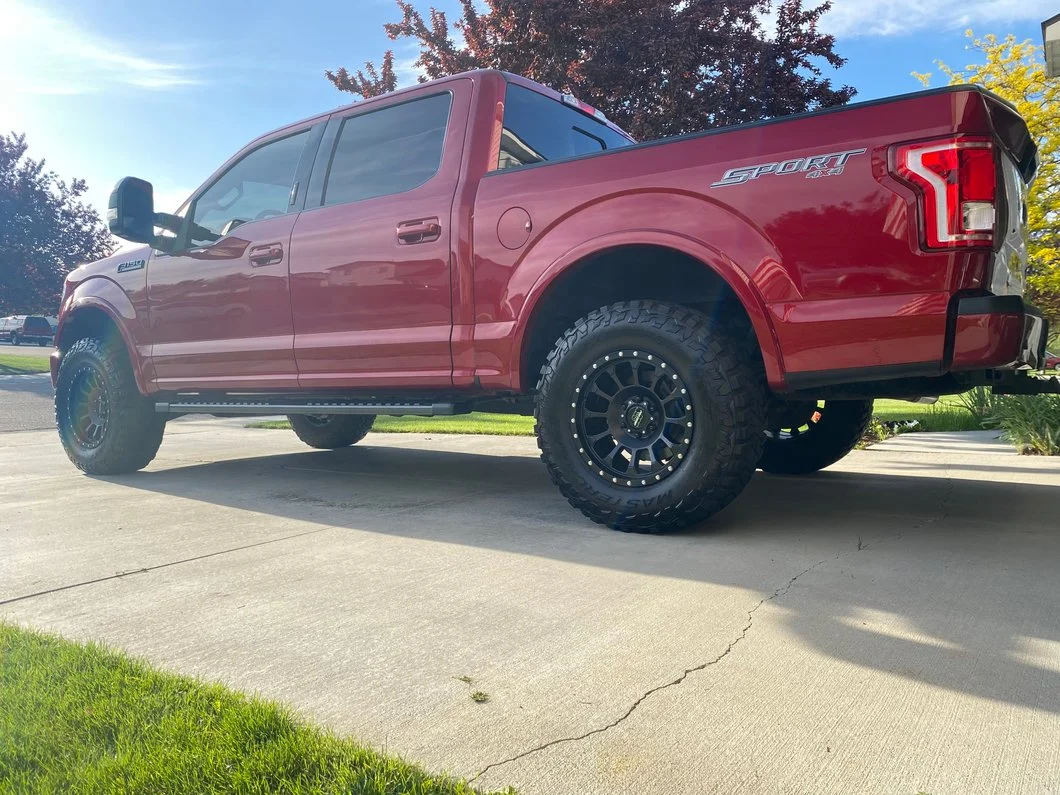
Beyond Bolt Pattern — Offset, Backspacing & Center Bore
![]() Bolt pattern gets you through the door, but it's not the only spec that determines whether a wheel fits your truck correctly. Three additional measurements matter:
Bolt pattern gets you through the door, but it's not the only spec that determines whether a wheel fits your truck correctly. Three additional measurements matter:
- Wheel offset is the distance (in millimeters) from the wheel's mounting surface to its centerline. A positive offset pushes the wheel inward toward the suspension; a negative offset pushes it outward for a wider stance. Getting offset wrong can cause tire rub on the fender or suspension components.
- Backspacing measures the distance from the wheel's inner edge to the mounting surface. It's related to offset but expressed in inches and measured from the opposite reference point. Lower backspacing = more of the wheel sits outside the fender.
- Center bore is the diameter of the hole in the center of the wheel that fits over your hub. A hub-centric wheel has a center bore that matches your truck's hub diameter exactly, which centers the wheel and eliminates vibration. If the wheel's center bore is larger than your hub (common with aftermarket and dual-drilled wheels), you'll need a hub-centric ring to fill the gap.
For a deeper breakdown of how these specs work together, check out our complete truck wheel guide. It covers offset charts, backspacing calculators, and how to figure out the right combination for your specific truck and tire setup.
When you're ready to find wheels that match your truck's bolt pattern, offset, and hub bore, explore our full collection of truck wheels and rims. We carry hundreds of styles from brands like Fuel, Pro Comp, Method, and more — and every listing is filtered by your year, make, and model so you'll only see wheels that actually fit.
Related Content
Frequently Asked Questions About Truck Wheel Bolt Patterns
These are the most common bolt pattern questions we see from truck owners shopping for aftermarket wheels.
What Is a Bolt Pattern on a Truck?
A bolt pattern is the arrangement of lug holes on your truck's wheel hub, expressed as two numbers — the lug count and the diameter of the circle they form. For example, 6x139.7 means six lugs on a 139.7 mm circle. This measurement must match between your hub and any wheel you install for safe, proper fitment.
How Do I Find the Bolt Pattern on My Truck?
The fastest method is an online lookup by year, make, and model. You can also check your owner's manual, look for a stamp on the back of your factory wheel, or measure it yourself with calipers. For even-lug wheels, measure center-to-center across opposite holes. For 5-lug wheels, measure center-to-far-edge of the farthest hole.
What Bolt Pattern Is a Ford F-150?
Ford F-150 trucks from 2004 to the present use a 6x135 mm bolt pattern with an 87.1 mm hub bore. Earlier F-150s (1997–2003) used a 5x135 pattern. The F-250 and F-350 Super Duty models use an 8x170 pattern, so Super Duty wheels won't fit an F-150 and vice versa.
What Bolt Pattern Is a Chevy Silverado 1500?
Every Chevy Silverado 1500 from 1999 to the present uses a 6x139.7 mm (6x5.5") bolt pattern with a 78.1 mm hub bore. This is the most common half-ton truck bolt pattern in production and is shared with the GMC Sierra 1500, Toyota Tacoma, Toyota 4Runner, and Nissan Titan.
What Bolt Pattern Is a Ram 1500?
The Ram 1500 bolt pattern depends on model year. Trucks from 2002 to 2018 use a 5x139.7 mm (5x5.5") pattern. The redesigned 2019+ Ram 1500 (DT platform) moved to a 6x139.7 mm pattern. The Ram 1500 Classic continued the 5-lug pattern through its production run, so always verify by year and trim.
Is 5x5 and 5x5.5 the Same Bolt Pattern?
No. A 5x5" pattern equals 5x127 mm, while a 5x5.5" pattern equals 5x139.7 mm — a 12.7 mm difference in bolt circle diameter. Wheels designed for one pattern will not fit the other. This is one of the most common mix-ups when shopping for truck wheels, so always double-check units.
Are Dual-Drilled Wheels Safe?
Yes, dual-drilled wheels are safe when properly engineered and installed with hub-centric rings. The dual pattern itself doesn't create a safety issue — the risk comes from skipping the hub-centric ring (which centers the wheel) or using the wrong lug seat type. Buy quality dual-drilled wheels and have them fitted correctly for your specific bolt pattern.
Can You Put 6-Lug Wheels on a 5-Lug Truck?
Not directly. The lug count must match between your wheel and hub — a 6-lug wheel won't bolt onto a 5-lug hub. The only way to run a different lug count is with a bolt pattern adapter, which bolts to your hub and provides a new bolt pattern on the outer face. Adapters work but add a connection point, so matching the factory pattern is always safest.
What Does a 6x139.7 Bolt Pattern Fit?
The 6x139.7 mm (6x5.5") bolt pattern fits the Chevy Silverado 1500, GMC Sierra 1500, Ram 1500 (2019+), Toyota Tacoma, Toyota 4Runner, Toyota Tundra (2022+), Nissan Titan, Ford Bronco (2021+), and Ford Ranger (2019+). It's the most widely used half-ton truck bolt pattern, giving you the largest selection of aftermarket wheels.
What's the Difference Between 8x165.1 and 8x170 Bolt Patterns?
These two 8-lug patterns are less than 5 mm apart but are not interchangeable. The 8x165.1 (8x6.5") pattern fits Ram 2500/3500 and older Chevy/GMC HD trucks (pre-2011), while the 8x170 (8x6.69") pattern fits Ford F-250 and F-350 Super Duty trucks. Forcing the wrong pattern can cause stud misalignment and wheel failure.